
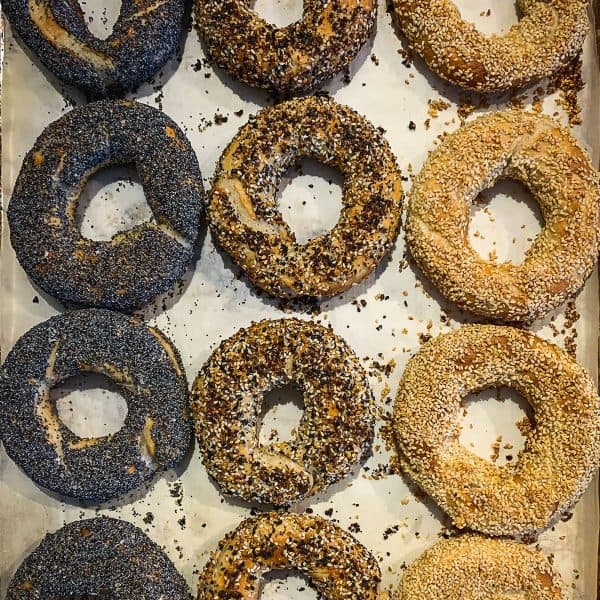
If you know, you know. Anyone that grew up in or visited Montreal knows about Montreal bagels and all their glory. This is a step-by-step recipe for those that are homesick and craving a taste of home. For me, these are simply the best bagels ever!

Ok, so first of all, this is not an authentic Montreal bagel recipe (but it’s pretty close). That’s because most home cooks simply don’t have a woodfired oven. We have to settle for our standard ovens. Based on the rave reviews on our YouTube video (linked below), it seems like these bagels are pretty close to the original.
If you are ever in Montreal, I recommend you check out St-Viateur Bagel or Fairmont Bagel for real deal wood fired bagels.
A little history
What makes Montreal bagels so special and different from their New York City cousins?
- Montreal bagels are typically hand rolled, resulting in uneven and misshapen bagels (we want this!) with a larger hole!
- They are dipped in boiling water spiked with honey prior to baking
- Woodfire is the go to cooking method, which gives these bagels a hint of smoke flavor.
Traditional recipes include malt and eggs but I developed this recipe for home cooks who probably don’t have malt syrup in their pantries. The malt syrup is important if you are looking to follow a traditional recipe.
Montreal-style bagels are sweet, chewy and not too salty. Don’t expect them to taste like a standard New York bagel.
Ingredients
For this recipe, you will need the following ingredients:
- Bread flour (All Purpose works as well, but bread flour with its higher protein content is the way to go)
- Active dry yeast
- Sugar
- Olive oil
- Salt
- Water
- Honey
- Toppings (sesame seeds, poppy seeds, everything bagel seasoning)
Equipment
Although the dough can be mixed by hand, I highly recommend you use a stand mixer if you have one.
I also recommend a kitchen scale to precisely weigh your ingredients.
Method
This is a detailed rundown of the recipe, from A to Z. I recommend you watch the YouTube video as well to help you get a better understanding of the process.
Prepare the dough
1. Yeast Mixture. This recipe starts with preparing the yeast mixture. In a Pyrex measuring cup, combine 415g (1 3/4 cups) of warm water with 1 packet of dry yeast (2 1/4 teaspoons) and 4 tablespoons of sugar. Mix well until the yeast dissolves and let the mixture activate for a few minutes.
2. Dry ingredients. Measure 700g (about 5 cups) of bread flour and add it to the bowl of a stand mixer. Add 1 teaspoon of salt to the flour.

3. Mix. Add your yeast mixture, followed by 2 tablespoons of olive oil.
4. Knead. With the dough hook attachment, run the stand mixer for 8-10 full minutes on low speed, until you have a nice, supple and soft dough.
NOTE: This recipe has been tested many times, but if you find your dough is too wet and not holding together, add more flour, 1 tablespoon at a time, until you get a doughball that is soft and yet holds its shape.
5. Rise. Transfer the dough ball to an oiled bowl (use canola oil or olive oil) and cover it with a clean tea towel.
6. Proof. Allow it to proof for 1 hour, or until doubled in size. You can also proof it in the stand mixer bowl itself, just make sure to oil your doughball well so it doesn’t stick.

Shape the bagels
7. Divide dough. When the dough has risen, punch it back and divide it into 12 equal pieces (about 100g each). Use your kitchen scale. Shape each piece into a tight ball and rest them on your kitchen counter for 5 minutes so that the gluten can relax.
8. Form your dough sausages. On an unfloured work surface, press the dough ball down and flatten it, bring the left and right sides of the dough circle together to create a rough rectangle. Starting from the bottom of the rectangle, roll upwards, so you end up with a tight cylinder, or small sausage-shaped dough piece. Rest your dough sausages for 5 minutes.

9. Roll your bagels. Roll each of the dough sausages into an 8-10 inch long piece. Bring both ends together and overlap them by an inch or two, and using pressure from your palms, continue rolling until both ends join together and you end up with your rolled bagel. Repeat for remaining bagels.
10. Rest. Rest your formed bagels on a floured surface for 30-60 minutes. Make sure to cover them with plastic wrap or a towel so they don’t dry out. We want them to rise again.
Boiling and baking the bagels
11. Prepare. Preheat your oven temperature to 450°F/230°C and prepare your topping stations. In small plates, place sesame seeds, poppy seeds or whatever your preferred bagel topping is. Honey bath. In a large pot (shallow wide preferred) filled with water, dilute 2 tablespoons of honey (you can use more here, up to 1/4 cup) and bring to a simmer.
12. Boil. Using your hands, gently drop a bagel into the hot water and honey bath. Cook the bagels for about 45 seconds on each side.

13. Dress. Use a slotted spoon to transfer the hot bagel to the topping station and apply your topping generously. Transfer to a prepared baking sheet (lined with parchment paper). Repeat this process with your remaining 11 bagels.
14. Bake. Bake the bagels in the preheated oven for 16 minutes. They should be nice and golden brown. Allow them to rest for at least 30 minutes before cutting into them. You can also transfer them to a cooling rack if you want to.
What to serve Montreal Style Bagels with
Enjoy with cream cheese, lox or your favorite vegetables, cheeses and spreads. You can enjoy them with hummus, mutabal or labneh balls. Serve them for breakfast along side some Turkish Eggs (Cilbir).
Storage
Store your bagels in a ziplock bag on your counter for up to 3 days. If you haven’t finished them by then, you can refrigerate for another 2 days or simply slice them and freeze them in a freezer bag. They will last in the freezer for several months.
Expert tips
- I recommend you use gloves (latex or nitrile) to help you handle the hot bagels. I also recommend you work with one bagel at a time, when you make this recipe for the first time. As you get more comfortable, you can boil the bagels 2 or 3 at a time.
- If using a convection oven, you don’t need to flip the tray. If using a conventional oven with no fan, turn the tray 180 degrees so get an even cook on all the bagles.
Video
I have a YouTube Video that shows takes you through this recipe:
FAQ
Montreal bagels are typically hand-rolled, resulting in uneven and misshapen bagels with large holes! They are dipped in boiling water spiked with honey before baking in a wood-fired oven. New York bagels are cakier in texture and have a small hole. Both are delicious.
There’s a lot of history behind why bagels are boiled. Technically, it is done so that the crust can set and also allow the toppings to stick before baking.
If you make these Montreal Style Bagels, please take a moment to rate the recipe and leave a comment below. It’s such a help to others who want to try the recipe. For more Urban Farm and Kitchen, follow along on Instagram, Facebook, and Pinterest, visit the Urban Farm Shop, or subscribe for new posts via email.
Other baking recipes you will enjoy
Star Bread with Cheese and Herbs
Cherry Tomato Puff Pastry Tart
Montreal Style Bagel Recipe
Equipment
- Stand Mixer
- Kitchen Scale – Use the scale for the water and flour. The rest of the ingredients can be measured out with cups and tea and tablespoons.
Ingredients
- 415 grams Water, warm – approx. 1 ¾ cups
- 2 ¼ teaspoon Dry yeast – 7 grams
- 4 tablespoon Sugar – 50 grams
- 700 grams Bread Flour (or All Purpose) – approx. 5 ½ cups
- 1 teaspoon Kosher salt – 6 grams
- 2 tablespoon Olive Oil – 30ml
Honey Water Bath
- ¼ cup Honey – 85 grams
- Enough water to fill a shallow pot
Toppings
- Sesame Seeds
- Poppy Seeds
- Everything Bagel Mix
Instructions
Prepare the dough
- Preparing the yeast mixture. In a Pyrex measuring cup, combine 415g (1 ¾ cups) of warm water with 1 packet of dry yeast (2 ¼ teaspoons) and 4 tablespoons of sugar. Mix well and let the yeast activate for a few minutes.
- Measure 700g (about 5 ½ cups) of bread flour and add it to the stand mixer bowl. Add 1 teaspoon of salt to the flour. Add your yeast mixture, followed by 2 tablespoons of olive oil.
- With the hook attachment, run the stand mixer for 8-10 minutes, until you have a nice and supple dough.
- NOTE: This recipe has been tested many times, but if you find your dough is too wet and not holding together, add more flour, 1 tablespoon at a time, until you get a doughball that is soft and yet holds its shape.
- Transfer the dough ball to an oiled bowl and allow it to proof for 1 hour, or until doubled in size. You can also proof it in the stand mixer bowl itself, just make sure to oil your doughball well so it doesn't stick.
Shape the bagels
- When the dough has risen, punch it back and divide it into 12 equal parts (about 100g each). Use your kitchen scale. Shape each piece into a tight ball and rest them on your kitchen counter for 5 minutes so that the gluten can relax.
- Form your dough sausages. Press the dough ball down and flatten it, bring the left and right sides of the dough circle together to create a rough rectangle. Starting from the bottom of the rectangle, roll upwards, so you end up with a tight cylinder, or small sausage-shaped dough piece. Rest your dough sausages for 5 minutes.
- Roll your bagels. Roll each of the dough sausages into an 8-10 inch long piece. Bring both ends together and overlap them by an inch or two, and using pressure from your palms, continue rolling until both ends join together and you end up with your rolled bagel. Repeat for remaining bagels.
- Rest your formed bagels on a floured surface for 30-45minutes (or less if your kitchen tends to be warm). Make sure to cover them with saran wrap or a towel so they don't dry out. We want them to rise slightly again.
Boiling and baking the bagels
- When your bagels are done proofing, it's time to preheat your oven and get your honey bath ready. Preheat your oven to 450F. In a shallow pot filled with water, dilute 2 tablespoons of honey (you can use more here, up to 1/4 cup) and bring to a simmer.
- Get your topping stations ready. In small plates, place sesame seeds, poppy seeds or whatever your preferred bagel topping is.
- Using your hands, gently drop a bagel into the hot water and honey bath. Cook the bagels for about 45 seconds on each side.
- Use a slotted spoon to transfer the hot bagel to the topping station and apply your topping generously. Transfer to a lined baking sheet. Repeat this process with your remaining 11 bagels.
- Bake the bagels in the preheated oven for 16 minutes. They should be nice and golden brown. Allow them to rest for at least 30 minutes before cutting into them.
Video
Notes
Nutrition
Nutrition information is automatically calculated, so should only be used as an approximation.
 Like this recipe? Rate & comment below!








Thanks for the recipe! I’ve made this 3 times and they were good every time. Dough was pretty easy to work with. I don’t have a mixer. The third time, I formed the bagels and refrigerated overnight to boil in the morning and they still turned out well. Added cinnamon and raisin to some during the folding before rolling. Also used 15% whole wheat flour once when I was short on bread flour and they came out well.
That’s wonderful to hear! Now I need to make some with cinnamon and raisin!!!
My bagels did not stay on top while simmering. Do you know why that could be? Thanks so much for the recipe, will let you know how they tasted.
Hi Donja. The reason bagels float when you put them in water is because of all the air pockets inside them when they rise. So if your bagels are sinking, they don’t have air pockets and that means they did not rise properly. This could be due to an old or inactive yeast, because they didn’t rise enough, or because they rose too much and deflated.
Thank you for the helpful tips. Surprisingly, kosher salt has been hard to find. Sold out in the 7 grocery stores I checked this week. It seems there has been a bit of a shortage due to a lengthy strike at the Windsor salt company (now over) and pickling season. However, right after reading your tips I found Diamond Crystals on Amazon at a sale price. The stars have aligned and there will be bagels this weekend!
Hi, Luay. I’m a Montrealer and keen to try your recipe. Fairmount and St. Viateur bagels have been family favourites over the years but being able to make our own will be wonderful. I’ve heard that kosher salt can vary a lot between brands. Apparently some taste saltier than others. Are there any brands in particular that you recommend for this recipe (or your other recipes)? And do you have a preference for coarse, fine, flaked etc.? Thanks for so generously sharing your expertise and passion for kitchen adventures!
You are right that different brands have different saltiness levels so using teaspoons is a challenge. You can go by weight. 6-7 grams of kosher salt should do.
The kosher salt you find in Canada (Windsor brand or the No Name Yellow box) is pretty standard so a teaspoon is just fine. If you are using Diamond Crystal (much more common to find in the US than Canada), you need to use more as this brand tends to be much lighter in weight so you may need to use more of it to get the same saltiness.
Hope this helps.
Hello!
This recipe looks great and I can‘t wait to try it. I was wondering if there was any way to incorporate Malt Powder?
Thank you!
Best, Lia
Hi! I haven’t experimented with malt powder at all. But you can sub out of some of the flour for it. Start with about 3 tablespoons of malt powder. You might have to make adjustments to the dough if it’s too wet/dry though. Let us know how it works out for you.
I have lived in Montreal for 16 years so I know what the real deal tastes like! In Montreal we often buy a container of cream cheese, get some fresh, warm bagels, and just rip pieces off and scoop the cream cheese – and it’s hard to eat just one!
I would say that this recipe is by far better than the New York Times Montreal bagel recipe. The flavour was great, the texture was great, and they toast well.
My only two notes are that I always bake with a kitchen scale and I found the dough to be quite sticky with 700g of flour. I had to add a significant amount of flour (probably about 1/2 a cup) to get the right consistency. The other thing is that there’s an error for the weight (in grams) for 1/4 cup of honey for the water. It should be about 85 grams (and personally I put even more because I like that hint of sweetness). Otherwise great recipe!!!
Thank you so much for the feedback. I’m glad you enjoyed them. I recently added metric measurements to this recipe and there was an issue with the software I used. You are indeed correct, 1/4 cup of honey is about 85 grams. Thank you for pointing that out!
4 tablespoons does not equal 12.5 grams (of sugar) Im surprised people loved the recipe when you dont know how much sugar to add???
Thanks for the feedback. We recently (1 week ago) added grams to the sugar, salt and yeast quantities per the request of our European followers as this recipe is getting quite a bit of worldwide attention. Clearly, there was a conversion error for the sugar, which we fixed. The good news is that the sugar amount doesn’t affect the recipe or final result in any noticeable way, especially if you use good-quality yeast. People have loved this recipe for years because it reminds them of home. There’s a nostalgia to it, especially for those who miss the taste of Montreal bagels. Isn’t that what food is all about? I hope you will try it and enjoy it like the thousands of people that have already.
I have made this recipe twice in the last week, both times with AP flour, proofed overnight in the fridge (the second time I reduce the amount of yeast, per comments above). I find this to be a very workable dough and didn’t have any issues shaping into bagels immediately after portioning, without rolling into balls then sausages first. Is there a specific reason behind the 3-step shaping process in the recipe, vs. rolling and shaping in one go?
The shaping process helps build a smaller and tighter crumb, which is characteristic of the Montreal bagel. Montreal bagels are not fluffy and tall, they are more dense in nature. But you can totally skip that part if you prefer.
I made this recipe and I didn’t flip the bagels b/c it didnt say to do so. The bottom half was still doughy after 16 minutes at 450 so I flipped them and popped them back in to bake the other side. Not sure where I went wrong.
I tested this recipe both ways. Flipping and not flipping and there was no significant difference. If you take too long to flip them they could deflate so I don’t recommend flipping them. I’m not sure where you went wrong, but they definitely should not be doughy after 16 minutes, especially if you pre-boiled them on both sides as outlined and your oven was pre-heated to 450 before you placed the sheet in.
Thank you for this superb recipe! I’ve made over 20 smaller batches already 😀 There one thing though that I would like to know more – I let the dough rise overnight in the fridge, and then ~15min after shaping. After a cold rise the dough looks explosive, nearly like focaccia…Is that ok? I deflate it and continue working without issues,but not sure if it’s the right way to handle this dough.
I did not test this recipe for an overnight rise. But normally, the rule of thumb is: if you plan to let a dough proof overnight in the fridge you should use less yeast, otherwise you end up with an over-proofed dough.